Police Clearance Online Philippines
Registration, requirements, appointment booking, fees, and release — one clear guide from account creation to claiming your certificate.
What Is Police Clearance and Who Needs One?
A National Police Clearance is an official document issued by the Philippine National Police (PNP) confirming that, based on its nationwide database, you have no pending criminal case or derogatory record. Unlike a Local Police Clearance that only checks one city or municipality, the national version cross-checks your name against PNP records across the whole country — which is why most employers, banks, and government offices now prefer it.
Whether it is your first time applying or you are renewing an expired one, this page walks you through the entire process: creating your NPCS account, booking a station appointment, paying your fee online, and understanding what happens if your name returns a “hit” status. For the full independent walkthrough with extra tips, you can also read the complete National Police Clearance online guide.
You typically need a police clearance if you are:
- Applying for a job — especially in security, government, or BPO roles
- An OFW preparing documents for overseas deployment
- A student applying for scholarships, exchange programs, or school clearance
- Applying for a visa or an immigration requirement abroad
- Applying for a firearm license, opening certain bank accounts, or renewing a government ID
Why apply online instead of walking in?
The old walk-in process meant arriving early, drawing a number, and waiting — sometimes for hours — with no guarantee you would be processed that day. The National Police Clearance System (NPCS) lets you register, choose a station and time slot, and pay in advance, so your in-person visit is limited to photo and fingerprint capture. It also gives you more payment options and lets you reschedule if something comes up.
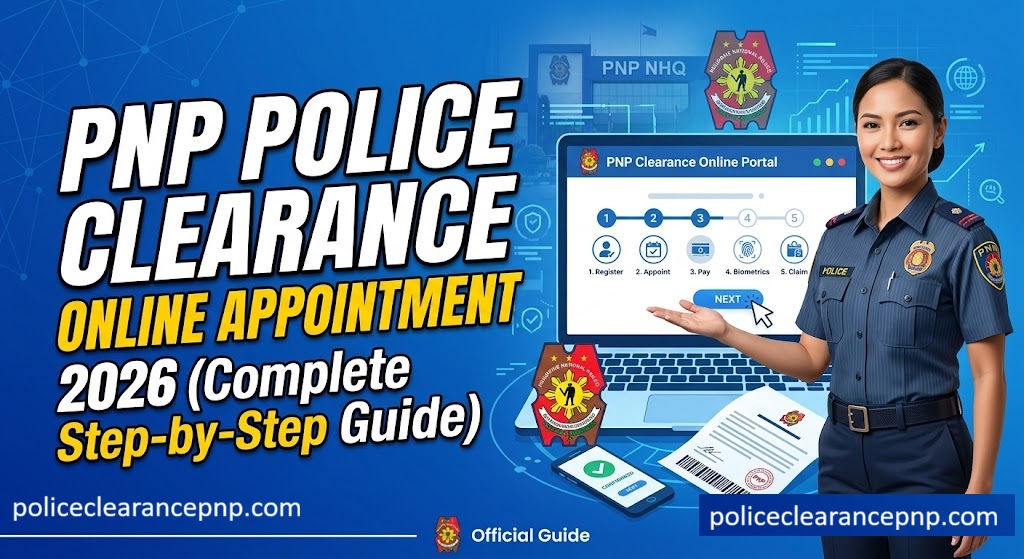
How It Works — Four Steps
From application to a claimed clearance, every stage is trackable from your account.
Register
Create your NPCS account with a valid ID online.
Apply
Fill out the clearance form and pay securely.
Schedule
Pick a nearby station and a time that suits you.
Claim
Get your clearance certificate at the station.
What This Guide Covers
Police Clearance Requirements
Prepare these before you start so your station visit goes quickly.
Before you begin your application
- An active personal email address (you will need to verify it)
- An active mobile number
- Proof of identity that matches the name you will register exactly
On your appointment day, bring:
- Two (2) valid IDs — originals, not photocopies
- Your payment receipt or proof of payment
- Your reference number (screenshot or printout)
Accepted valid IDs
The PNP accepts a wide range of identification documents. Any two of the following usually work:
A Barangay Residency Certificate from your barangay hall is an accepted substitute at most stations. Request it a few days before your appointment — not on the same day — so the barangay has time to process it and you avoid delaying your station visit. For the full ID breakdown, see the complete requirements checklist.
Special situations
First-time jobseekers: Under Republic Act 11261 (the “First Time Jobseekers Assistance Act”), individuals applying for their very first job can get their police clearance free of charge. Bring a Barangay Certification confirming you are a first-time jobseeker. Read the details in the RA 11261 fee waiver guide.
Minors (under 18): A parent or legal guardian must accompany the applicant to the biometrics appointment, along with the minor’s birth certificate or school ID and the guardian’s valid ID.
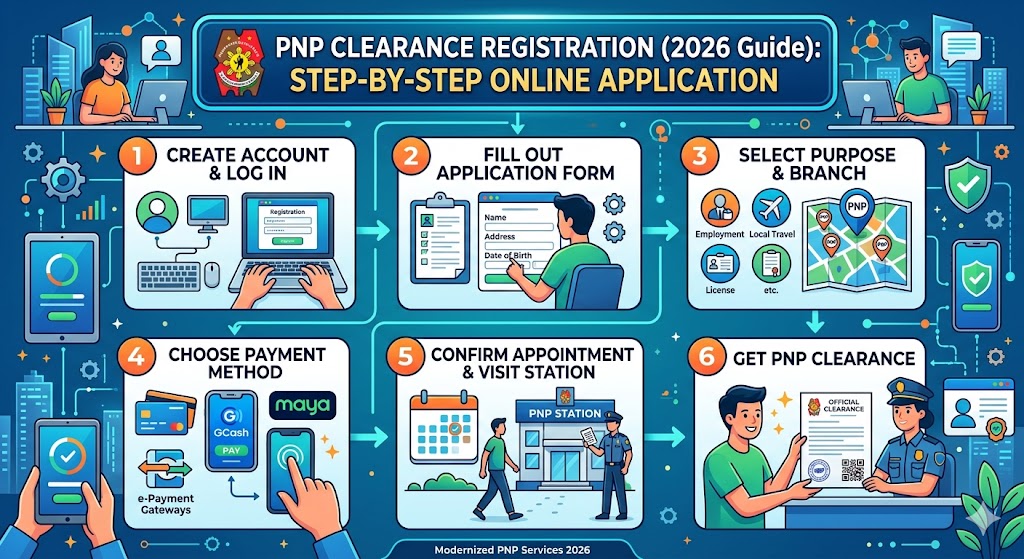
How to Register Online (Step by Step)
Before you begin, read and accept the Terms & Conditions. This step is mandatory before you can create your applicant profile.
Register for a National Police Clearance account
Visit the official portal at pnpclearance.ph and click Register. Complete the form with your full name (exactly as on your valid ID), date of birth, active email, mobile number, and a secure password. After submitting, check your inbox and click the verification link to activate your account.
Complete your applicant profile
Log in and fill in your baseline information: citizenship and nationality, place of birth, civil status, current address, height and weight, family details, and a high-resolution 2×2 ID photo with a plain white background.
If the verification email does not arrive within a few minutes, check your Spam or Junk folder. Never share your password or reference numbers with third-party “fixers” — keep your credentials confidential.
Ensure your name, birth date, and address match your government-issued ID character-for-character. Any mismatch can instantly reject or delay your application.
How to Book an Appointment
From your dashboard, start a clearance application and choose where and when to appear.
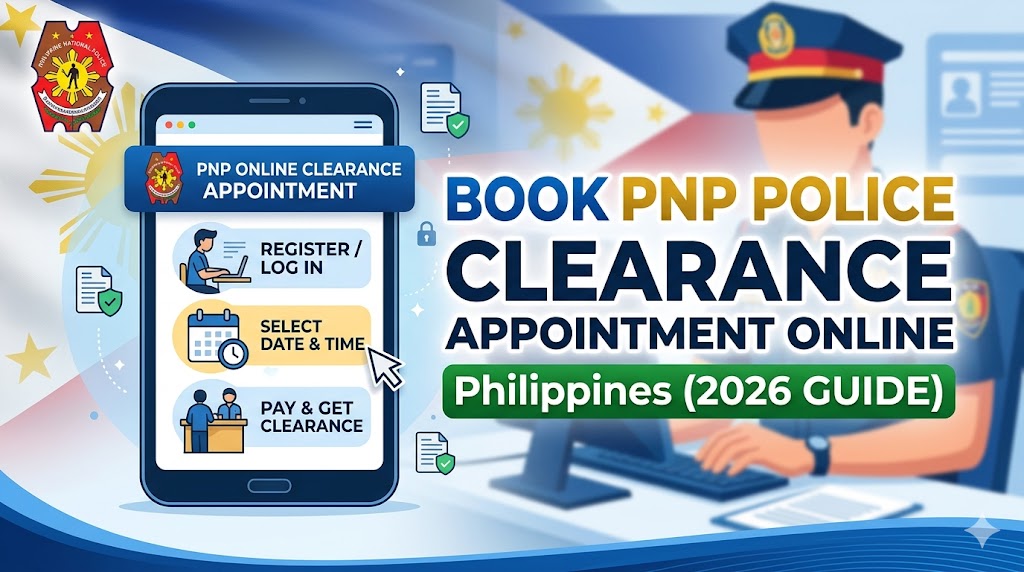
Book your police clearance appointment
Click Application for Clearance and provide your application purpose, preferred police station, an available date, and a time slot (AM or PM window).
Popular metropolitan stations fill up fast. If your local station shows zero availability, select a nearby regional branch with open slots — new slots also tend to open early in the morning.
Visit the police station for biometrics
Arrive at least 15 minutes before your window with your valid IDs and payment confirmation. An officer will guide you through fingerprint scanning, portrait capture, digital signature logging, and live identity verification — usually about 10–15 minutes depending on the queue.
Receive your clearance
When the record check completes with no hit, your certificate is printed and stamped on the spot. Review it carefully before leaving — if you spot a typo, tell the officer immediately so they can correct it.
Some stations turn away applicants who arrive out of dress code. Wear closed shoes (no slippers or open sandals), avoid sleeveless tops, shorts, or heavily ripped jeans. Collared shirts are preferred at some stations.
A no-show generally forfeits your slot, and payment is not automatically carried over — you will need to rebook through your account. To reschedule, do it through your NPCS account before the original date so your reference number and payment status stay intact.
Can foreign nationals apply?
Yes. Foreign nationals residing in the Philippines can generally apply, most often for a local employment permit, visa extension, or residency transaction. Typical requirements include a valid passport with an unexpired visa or residency stamp, an ACR I-Card if applicable, and proof of a local Philippine address. Requirements vary by station, so call ahead to confirm.
Specialized Certification (OFW / Overseas Applicants)
If you are applying under a specialized category — Filipino citizen working abroad, bedridden, petitioner, or a representative request — the flow adds a document-upload and certification step. Here is how it works.
Choose the certification category
From your dashboard, open Clearance Certification and pick the category that fits — for example, “Filipino citizen working or based in another country.” Review the listed requirements before continuing.
Provide your purpose and overseas address
Enter the purpose of your application and your current address abroad. This information prints on the certification, so check the spelling carefully.
Upload the required documents
Upload a recent 2×2 photo with a white background, a selfie holding a valid government ID, a copy of your passport, proof of OFW status, and a valid ID showing your Philippine address. Make sure the details match your NPCS account.
Save your application, then pay
Click Save Appointment to submit. Open Transaction History, tap Click Here to Pay, and complete payment. After confirmation, the One-Stop Shop (OSS) processes and approves your certification once record checks clear.
Download your certification
Once approved, log in and click Download Certificate — no station visit required for this certification category.
Biometric capture generally requires being physically present in the Philippines, so many OFWs use NBI Clearance for overseas needs. See the dedicated OFW police clearance guide for the full picture.
Payment Methods
The NPCS payment gateway routes through Land Bank of the Philippines — you do not need an actual Land Bank account to pay.
How to pay via GCash
- Open the GCash app and tap Pay Bills.
- Search for “Land Bank.”
- Enter the exact reference number from your NPCS confirmation — a single wrong digit can cause the payment to fail.
- Enter the amount due — typically ₱160 (₱150 base + roughly ₱10 convenience fee).
- Confirm and screenshot your receipt as a backup.
- Allow 1–2 banking days for the payment to reflect before your appointment.
Alternative payment channels
- 7-Eleven CLiQQ kiosk: Bills Payment → Government → search NPC / Land Bank, enter your reference number, pay at the counter.
- BancNet: available through participating banks’ online banking portals.
- Bayad Center: accepts walk-in payments using your NPCS reference number.
Anyone offering a police clearance with “no appointment needed” — skipping fingerprint and photo capture — is not legitimate. Biometric capture cannot be done on your behalf. Only register and pay through the official portal, and never send money to an individual claiming to “process” your clearance outside the system.
Processing Time
For most applicants, the National Police Clearance is a same-day release.
No “hit” — same day
Once biometrics are captured and your name clears the database, the certificate is printed and released the same day. On-site biometrics take about 10–15 minutes.
With a “hit” — 7–15 working days
If your name matches a record, the station refers your case for manual verification. You will submit additional documents, and processing typically takes 7–15 working days.
Online payment itself needs 1–2 banking days to reflect in the system, so pay a few days before your appointment rather than the night before.
Fees and Validity
| Item | Amount |
|---|---|
| Base clearance fee | ₱150 |
| GCash convenience fee | ~ ₱10 |
| 7-Eleven CLiQQ service fee | ~ ₱30 |
| BancNet fee | Varies by bank |
| First-time jobseekers (RA 11261) | FREE (with Barangay Certification) |
Expect a typical all-in total of ₱160–₱200 depending on your payment channel. For the complete channel-by-channel breakdown, see the 2026 fee guide.
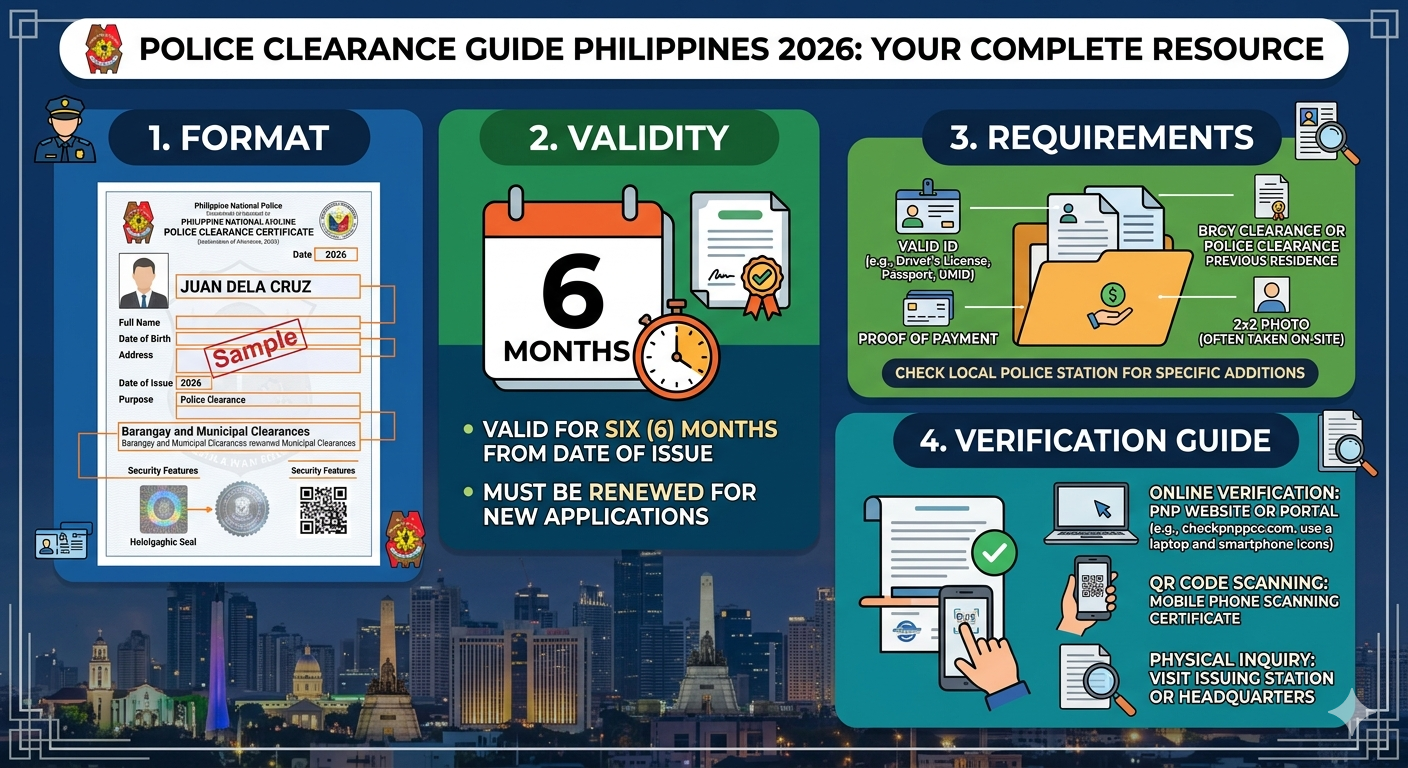
Your clearance is valid for exactly 6 months from the date of issuance — not from the date you booked. Mark your calendar from the day you actually receive the certificate.
Renewal Process
Renewal uses the exact same process as a brand-new application — there is no shortcut or “renewal-only” form in the portal.
- Log in to your existing NPCS account (or create one if you no longer have access).
- Start a new clearance application from your dashboard.
- Book a new appointment and pay the fee again.
- Visit the station for fresh biometrics and claim your updated certificate.
Can you renew early?
Yes. You can apply for a new clearance before your current one expires — there is no penalty for renewing early, which is useful ahead of a job application or visa filing.
Expired before you submitted it?
You will need to go through the process again. An expired clearance is not accepted by most agencies, even if it was valid when you first obtained it.
“Hit” Status: What It Means and What to Do
A “hit” is one of the most misunderstood parts of the process — and one of the most stressful. Here is the full picture.
A hit means your name partially or fully matches a name already in the PNP database with a recorded case. It does not mean you have a criminal conviction — it is a name-matching flag that requires manual verification. There are three common types: a same-name match (someone shares your name), a pending-case match (an active case to rule out), and — rarely — an actual record match.
What happens next
If you get a hit, you will not receive your clearance the same day. The station asks for additional verification documents — often an affidavit of identity or denial, a court clearance if applicable, and extra valid IDs — and refers your case for review. Resolution typically takes 7–15 working days, and most hits clear once you prove you are not the person with the matching record.
Very common Filipino names are statistically more likely to trigger a hit. If you have a common name, prepare your affidavit of identity in advance to speed up resolution.
Police Clearance vs NBI Clearance
They come from different agencies and check different databases — and they are not always interchangeable.
| Factor | National Police Clearance | NBI Clearance |
|---|---|---|
| Issued by | Philippine National Police | National Bureau of Investigation |
| Checks | PNP nationwide records | Court + judicial records |
| Best for | Local jobs, IDs, banking | Overseas work, visas, PRC exams |
| Validity | 6 months | 6 months – 1 year |
| Cost | ~ ₱150–200 | Generally higher |
Applying for a local job or ID? The National Police Clearance is usually enough. Applying for overseas work or a visa? You will likely need NBI Clearance and/or a PCC-OE, possibly apostilled. When unsure, ask the requesting employer or agency directly. For a deeper comparison, read NBI Clearance vs Police Clearance and how both differ from a Barangay Clearance.
Common Problems and Solutions
| Problem | What it means | How to fix it |
|---|---|---|
| Name mismatch | Your profile does not match your ID exactly | Edit your profile before your appointment so it matches your ID character-for-character |
| Payment not reflected | The transaction has not posted yet | Wait up to 2 banking days; contact Land Bank support if it still has not posted — don’t pay twice |
| Appointment slot full | High demand at your chosen station | Try a nearby station or check very early morning when new slots open |
| Verification email missing | Spam filtering or a typo in your email | Check spam/junk; if it never arrives, re-register with a different email provider |
| Application rejected | Incomplete documents or ID mismatch | Review the reason in your account, gather correct documents, and re-apply |
| Website not loading | High traffic or browser cache | Clear cache, use a private window, or try off-peak hours |
For personnel-account and payslip access questions, the PNP payslip online guide covers the separate personnel portal.
Frequently Asked Questions
Can I get a police clearance without a valid ID?
In most cases a Barangay Residency Certificate is accepted as a substitute if you have no other valid government-issued ID.
How much is police clearance?
The base fee is ₱150. With a small convenience or service fee from your payment channel, the typical all-in total is ₱160–200. First-time jobseekers may qualify for a free clearance under RA 11261.
How long does processing take?
With no hit, it is usually a same-day release. If your name returns a hit, expect 7–15 working days for manual verification.
Can I reschedule my appointment?
Yes. You can typically reschedule through your NPCS account before your original appointment date, subject to slot availability.
Is police clearance the same as NBI clearance?
No. They are issued by different agencies and check different databases, so they are not always interchangeable — especially for visa or embassy purposes.
Can I get a police clearance for someone else?
No. Biometric capture requires the applicant to be physically present, so you cannot apply or appear on someone else’s behalf.
Can minors apply?
Yes, but a parent or legal guardian must accompany them to the appointment, along with the minor’s birth certificate or school ID and the guardian’s valid ID.
What if I forgot my password?
Use the “Forgot password?” link on the sign-in screen to reset it via your registered email. If the reset email does not arrive, check your spam folder first.
How do I verify a police clearance online?
Most clearances now include a QR code or reference number that can be checked against the official NPCS system to confirm authenticity.
Can I apply from abroad?
Biometric capture generally requires being physically present in the Philippines. OFWs are usually advised to use NBI Clearance for overseas needs, or to complete the National Police Clearance while in the country.
How many days before expiry should I renew?
There is no fixed rule, but renewing 2–4 weeks before you need to submit it gives you buffer time for any processing delays or a hit.
Start Your Police Clearance Online
Applying online saves you the hours a walk-in used to cost — as long as you keep your details accurate, your documents ready, and your payment reference safe. Register, book a station appointment that fits your schedule, pay securely, then complete biometrics and claim your clearance.
Disclaimer: This page is an informational guide about the National Police Clearance System. Always confirm current fees, exact profile requirements, and station procedures on the official portal at pnpclearance.ph, as administrative details can change without notice. For an independent, in-depth walkthrough, see nationalpoliceclearance.org.